
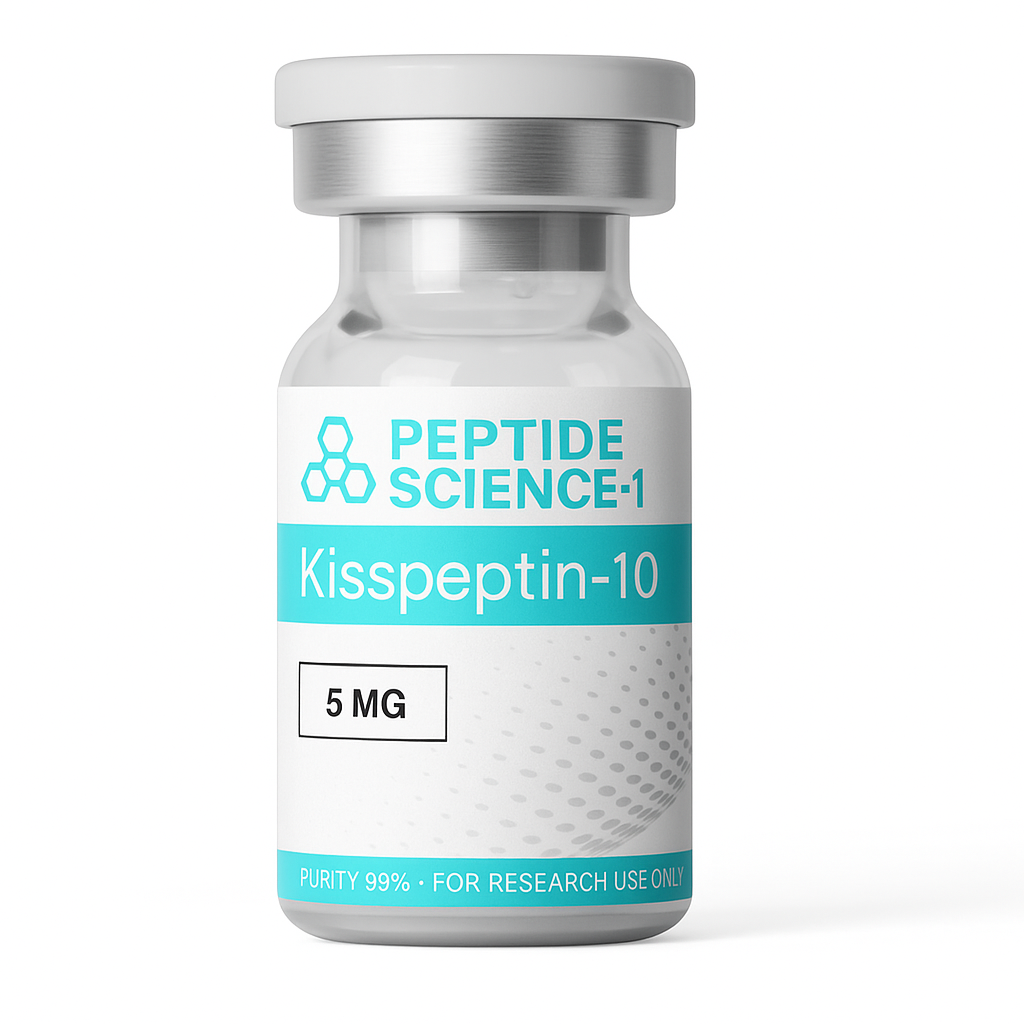


Kisspeptin-10 10mg — The Master Hypothalamic Neuropeptide for Reproductive Endocrinology & Hormonal Research
Kisspeptin-10 is the biologically active C-terminal decapeptide fragment of the larger kisspeptin family — neuropeptides encoded by the KISS1 gene and recognized as the most potent endogenous regulators of the hypothalamic-pituitary-gonadal (HPG) axis ever identified. Acting through the G protein-coupled receptor GPR54 (also known as KISS1R), Kisspeptin-10 functions as the principal upstream gatekeeper of gonadotropin-releasing hormone (GnRH) secretion, the foundational hormonal signal that initiates the entire cascade of reproductive endocrine function in both males and females. Without sufficient kisspeptin signalling, the HPG axis falls silent — making Kisspeptin-10 one of the most physiologically critical neuropeptides in human biology.
Supplied in a precision-dosed 10mg lyophilized research vial, our Kisspeptin-10 provides investigators with an analytically verified, high-purity tool for exploring some of the most important and rapidly evolving frontiers in endocrinology: the neuroendocrine regulation of fertility, the mechanisms of puberty onset, the hormonal basis of hypogonadism, the interplay between energy status and reproductive function, and the emerging role of kisspeptin signalling in metabolic and cardiovascular research contexts. Whether your laboratory studies GnRH pulse dynamics, LH surge mechanisms, or the translational potential of kisspeptin-based therapeutics, this 10mg vial delivers the quality and confidence your science demands.
What Is Kisspeptin-10? Discovery, Structure & Biological Role
The kisspeptin family was first identified in 1996 as a product of the KISS1 tumour suppressor gene in melanoma cells, initially named ‘metastin’ for its apparent ability to suppress cancer metastasis. It was not until 2003 that two independent research groups simultaneously discovered that loss-of-function mutations in the GPR54 receptor gene caused complete failure of puberty in humans and animal models — revealing that kisspeptin signalling was absolutely essential for reproductive function. This discovery transformed our understanding of the HPG axis and established Kisspeptin-10 as one of the most important neuropeptide research tools in reproductive medicine.
The KISS1 gene encodes a 145-amino acid precursor protein (prepro-kisspeptin) that is cleaved post-translationally into several biologically active fragments, the most potent of which is Kisspeptin-10 — the 10-amino acid C-terminal sequence that retains
full GPR54 agonist activity. The C-terminal RF-amide motif (Arg-Phe-NH2) present in Kisspeptin-10 is essential for receptor binding and activation, and is conserved across species, underscoring the evolutionary importance of this signalling pathway. Kisspeptin-10 is the most commonly employed isoform in research settings due to its compact size, high potency, and well-characterised receptor pharmacology.
Molecular Identity & Chemical Properties
Kisspeptin-10 carries the amino acid sequence Tyr-Asn-Trp-Asn-Ser-Phe-Gly-Leu-Arg-Phe-NH2, corresponding to residues 112-121 of the human prepro-kisspeptin precursor. Its molecular formula is C63H83N15O12, with a molecular weight of approximately 1302.44 g/mol. The amidated C-terminus (Phe-NH2) is critical for GPR54 binding affinity and biological potency. In lyophilized form, Kisspeptin-10 presents as a white to off-white powder with excellent reconstitution characteristics in aqueous vehicles including bacteriostatic water or sterile physiological saline.
The GPR54 Receptor & HPG Axis Signalling
Kisspeptin-10 exerts its biological effects exclusively through GPR54 (KISS1R), a Gq-coupled receptor expressed in high density on GnRH neurons within the hypothalamic arcuate nucleus and anteroventral periventricular nucleus. Upon Kisspeptin-10 binding, GPR54 activation triggers phospholipase C-mediated intracellular calcium release and protein kinase C activation, resulting in sustained membrane depolarization of GnRH neurons and robust, pulsatile GnRH secretion into the portal circulation. This GnRH signal then drives pituitary release of luteinizing hormone (LH) and follicle-stimulating hormone (FSH), which in turn regulate gonadal steroidogenesis and gametogenesis — completing the HPG axis cascade.
Research Applications & Scientific Significance of Kisspeptin-10
1. Reproductive Endocrinology & HPG Axis Modulation
The foundational research application of Kisspeptin-10 is in the direct stimulation and characterisation of GnRH pulsatility and downstream LH/FSH secretion dynamics. In both animal and human research models, acute Kisspeptin-10 administration produces a rapid, dose-dependent surge in LH plasma concentrations — an effect so reliable that intravenous Kisspeptin-10 challenge tests are now used clinically to assess hypothalamic GnRH reserve and distinguish central from peripheral causes of hypogonadism. Researchers use this robust LH response as a sensitive bioassay for probing the integrity and plasticity of hypothalamic kisspeptin-GnRH circuitry.
2. Puberty Onset & Neuroendocrine Maturation Research
Kisspeptin neurons in the arcuate and anteroventral periventricular nuclei are now understood to be the principal neuroendocrine triggers of puberty onset in mammals. The dramatic increase in hypothalamic kisspeptin expression at the onset of puberty — driven by genetic, metabolic, and circadian inputs — initiates the reactivation of GnRH pulsatility that characterises pubertal development. Kisspeptin-10 is an essential research tool for investigating the cellular and molecular mechanisms
full GPR54 agonist activity. The C-terminal RF-amide motif (Arg-Phe-NH2) present in Kisspeptin-10 is essential for receptor binding and activation, and is conserved across species, underscoring the evolutionary importance of this signalling pathway. Kisspeptin-10 is the most commonly employed isoform in research settings due to its compact size, high potency, and well-characterised receptor pharmacology.
Molecular Identity & Chemical Properties
Kisspeptin-10 carries the amino acid sequence Tyr-Asn-Trp-Asn-Ser-Phe-Gly-Leu-Arg-Phe-NH2, corresponding to residues 112-121 of the human prepro-kisspeptin precursor. Its molecular formula is C63H83N15O12, with a molecular weight of approximately 1302.44 g/mol. The amidated C-terminus (Phe-NH2) is critical for GPR54 binding affinity and biological potency. In lyophilized form, Kisspeptin-10 presents as a white to off-white powder with excellent reconstitution characteristics in aqueous vehicles including bacteriostatic water or sterile physiological saline.
The GPR54 Receptor & HPG Axis Signalling
Kisspeptin-10 exerts its biological effects exclusively through GPR54 (KISS1R), a Gq-coupled receptor expressed in high density on GnRH neurons within the hypothalamic arcuate nucleus and anteroventral periventricular nucleus. Upon Kisspeptin-10 binding, GPR54 activation triggers phospholipase C-mediated intracellular calcium release and protein kinase C activation, resulting in sustained membrane depolarization of GnRH neurons and robust, pulsatile GnRH secretion into the portal circulation. This GnRH signal then drives pituitary release of luteinizing hormone (LH) and follicle-stimulating hormone (FSH), which in turn regulate gonadal steroidogenesis and gametogenesis — completing the HPG axis cascade.
governing this developmental transition, including the role of steroid hormone feedback, nutritional status, and circadian biology in timing pubertal maturation.
3. Hypogonadism & Fertility Disorder Investigation
Defects in kisspeptin-GPR54 signalling are now firmly established as a cause of idiopathic hypogonadotropic hypogonadism (IHH) in humans. Loss-of-function mutations in KISS1 or KISS1R result in complete failure of puberty and infertility, while gain-of-function mutations cause precocious puberty — demonstrating the exquisite sensitivity of the reproductive axis to kisspeptin tone. In research settings, Kisspeptin-10 is used to model and investigate hypogonadal states, evaluate hypothalamic responsiveness in patients with reproductive disorders, and develop mechanistic frameworks for novel fertility therapeutics targeting the kisspeptin-GnRH interface.
4. Metabolic Regulation & Energy Homeostasis Research
An increasingly important area of kisspeptin research concerns the integration of metabolic signals with reproductive function — a phenomenon known as metabolic gating of reproduction. Kisspeptin neurons in the arcuate nucleus co-express neuropeptide Y, leptin receptors, and other metabolic sensors, positioning them as key integrators of nutritional status and body energy reserves with reproductive readiness. Research using Kisspeptin-10 has illuminated how states of negative energy balance — as seen in anorexia nervosa, excessive exercise, or malnutrition — suppress HPG axis activity through reduced kisspeptin tone, providing a molecular explanation for exercise-induced and nutritional amenorrhoea.
5. Cardiovascular & Anti-Metastatic Research
Beyond its reproductive roles, kisspeptin signalling has been explored in cardiovascular biology — where GPR54 expression in vascular endothelium and smooth muscle suggests roles in vascular tone and angiogenesis regulation — and in oncology research, where kisspeptin’s original identity as the KISS1 metastasis suppressor gene product continues to stimulate investigation into its capacity to inhibit tumour cell invasion and migration. Kisspeptin-10 serves as the primary pharmacological probe in these emerging research areas, enabling dissection of GPR54-mediated signalling in non-reproductive tissue contexts.
Product Specifications: Kisspeptin-10 — 10mg Vial
Analytical & Technical Data
- Peptide name: Kisspeptin-10 (KP-10 / Metastin 45-54)
- Sequence: Tyr-Asn-Trp-Asn-Ser-Phe-Gly-Leu-Arg-Phe-NH2
- Molecular formula: C63H83N15O12
- Molecular weight: ~1302.44 g/mol
- CAS number: 374683-26-8
- Vial presentation: 10mg lyophilized powder
- Purity: ≥99% (HPLC and mass spectrometry verified)
- Appearance: White to off-white lyophilized powder
- Reconstitution: Bacteriostatic water or sterile saline
- Storage: 2–8°C refrigerated; –20°C for long-term preservation
Quality Assurance & Documentation
Each 10mg vial of Kisspeptin-10 is produced under GMP-aligned synthesis and purification conditions, with full traceability from raw amino acid inputs through to final lyophilized product. Independent third-party analytical testing confirms peptide identity by high-resolution mass spectrometry, sequence integrity, purity by reverse-phase HPLC, and endotoxin levels suitable for in vitro and in vivo preclinical research applications. A batch-specific Certificate of Analysis (CoA) is available with every order to support your institutional quality records.
Research & Regulatory Classification
Kisspeptin-10 10mg is supplied exclusively for in vitro laboratory research and preclinical scientific investigation. It is not a licensed therapeutic product in this vial presentation and is not intended for human or veterinary self-administration. All procurement, handling, and experimental use must adhere fully to applicable institutional ethics approvals and jurisdictional regulations governing research peptides.
Why Source Kisspeptin-10 From Our Research Peptide Catalogue?
Kisspeptin-10’s biological potency is exquisitely sensitive to sequence integrity and C-terminal amidation status — even minor synthesis or purification deficiencies can dramatically compromise GPR54 binding affinity and the reliability of your experimental outcomes. Our Kisspeptin-10 is synthesised by Fmoc solid-phase peptide synthesis with rigorous C-terminal amidation chemistry, purified by preparative HPLC to greater than 99% purity, and verified by high-resolution mass spectrometry to confirm the correct molecular mass and sequence.
With a 10mg vial format providing substantial material for multi-experiment protocols, full analytical documentation, and a specialist research support team, we are the first choice for endocrinologists, reproductive biologists, neuroscientists, and metabolic researchers who depend on Kisspeptin-10 for critical experimental work. Trust the supplier that holds its peptides to the same standards you hold your science.
Precision synthesis. Hormonal clarity. Research without compromise.
Be the first to review “Kisspeptin-10 10mg”
Related products
Peptide
Peptide
Peptide
Peptide
Peptide
Peptide
Peptide

Peptide
Reviews
There are no reviews yet.