CagriSema 5mg The Pioneering Dual-Hormone Research Peptide Combining Cagrilintide and Semaglutide for Next-Generation Obesity Science
There are rare moments in the history of metabolic medicine when multiple streams of scientific discovery converge to produce something genuinely transformative. CagriSema represents exactly such a moment. By combining two of the most clinically validated and mechanistically complementary satiety hormone systems — the amylin receptor pathway targeted by Cagrilintide and the GLP-1 receptor pathway activated by Semaglutide — into a single dual-acting research agent, CagriSema 5/5mg is opening entirely new frontiers in the scientific understanding of obesity, appetite regulation, and cardiometabolic disease.
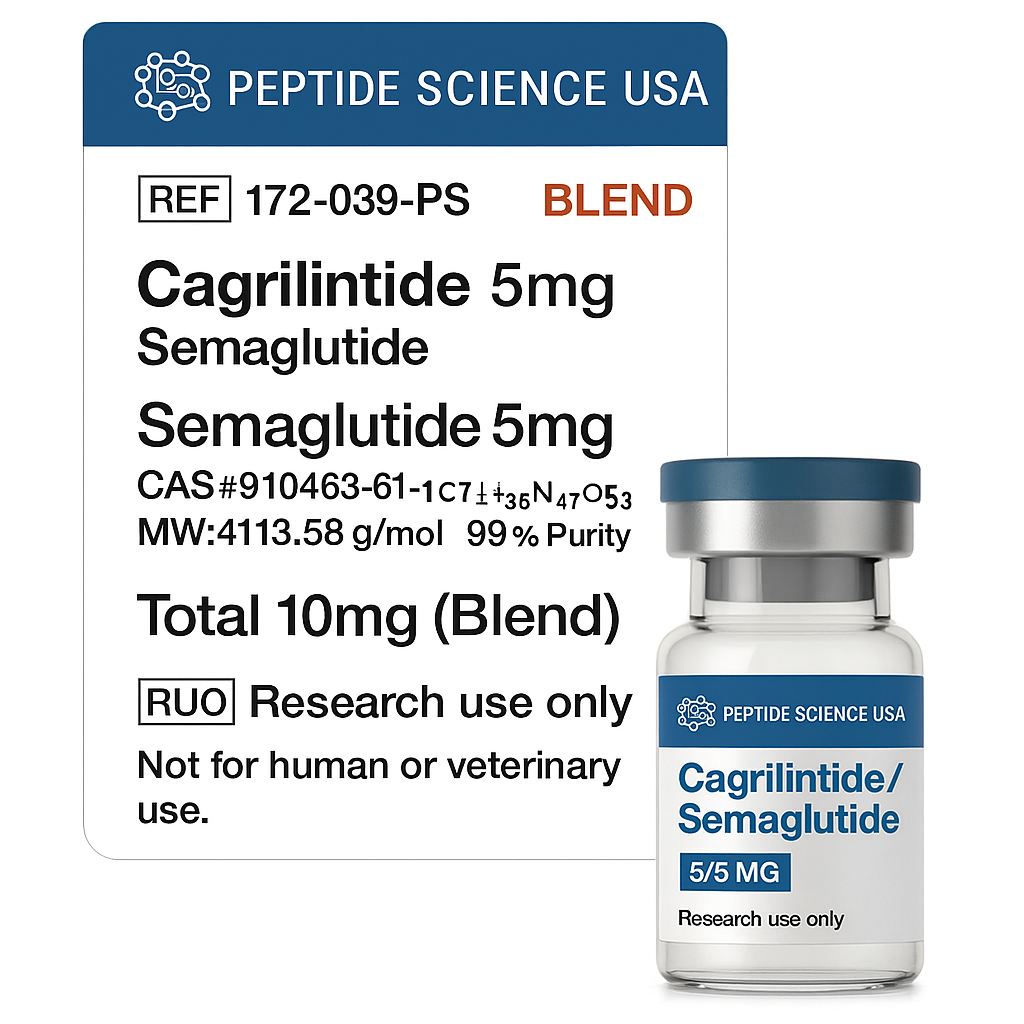
CagriSema 5/5mg is a research-grade co-formulation delivering 5mg of Cagrilintide, the long-acting amylin analog developed by Novo Nordisk, alongside 5mg of Semaglutide, the GLP-1 receptor agonist that has already redefined clinical expectations for pharmacological weight management. Together, these two peptides engage complementary and largely non-overlapping neurological and peripheral circuits governing food intake and energy balance, producing synergistic effects on body weight reduction that substantially exceed what either compound achieves in isolation. This product is supplied exclusively for qualified scientific research purposes.
The Scientific Rationale for Dual-Hormone Co-Activation in Obesity Research
To appreciate why CagriSema represents such a significant advance in metabolic research, it is essential to understand the biological logic underpinning the combination of amylin and GLP-1 receptor co-activation. Obesity is not a disorder of a single dysregulated hormone or pathway. It is a complex, polygenic, neuroendocrine condition in which multiple appetite-regulating systems are simultaneously disrupted, and in which single-pathway interventions — however powerful — inevitably encounter physiological limits imposed by compensatory mechanisms in other circuits.
The GLP-1 receptor agonist pathway has proven extraordinarily effective at reducing caloric intake and body weight through mechanisms including enhanced satiety signaling, delayed gastric emptying, reduced reward-driven eating, and improved insulin secretion. Yet even at the highest approved doses of Semaglutide 2.4mg, average weight loss plateaus in the range of 15 to 17 percent — a clinically impressive but biologically limited outcome shaped in part by counter-regulatory increases in hunger signaling through pathways that GLP-1 does not directly address.
The amylin receptor pathway offers a mechanistically distinct and functionally complementary solution. Amylin and its analogs suppress appetite through brainstem circuits — particularly the area postrema and nucleus tractus solitarius — that operate largely independently of the hypothalamic and vagal pathways through which GLP-1 exerts its primary effects. Amylin additionally slows gastric emptying through different mechanisms than GLP-1, suppresses glucagon through a distinct pancreatic pathway, and may engage hedonic and reward circuits in ways that further reinforce reduced food-seeking behavior. The result of activating both systems simultaneously is a more comprehensive suppression of hunger and food intake than either pathway can achieve alone.
Why Cagrilintide Is the Ideal Amylin Partner for Semaglutide
Not all amylin analogs are equally suited to combination with a GLP-1 receptor agonist. Pramlintide, the first approved amylin analog, requires three times daily injection due to its extremely short half-life — an administration burden that is entirely incompatible with the once-weekly profile of Semaglutide. Cagrilintide’s seven-day half-life, achieved through fatty acid acylation and strategic amino acid substitutions, makes it the only amylin analog with a pharmacokinetic profile compatible with once-weekly co-administration alongside Semaglutide. This matched dosing frequency is not merely a practical convenience — it ensures that both receptor systems are continuously engaged throughout the entire dosing interval, maintaining the synergistic signaling interaction that drives CagriSema’s exceptional efficacy profile.
Why Semaglutide at 5mg Represents an Optimal Research Dose
The 5mg dose of Semaglutide used in CagriSema 5/5mg is positioned above the highest dose currently approved for obesity pharmacotherapy (2.4mg weekly), reflecting the research context in which this co-formulation is being studied. Preclinical and early clinical dose-ranging work has suggested that higher Semaglutide doses continue to produce incremental weight loss benefits when combined with Cagrilintide, and that the tolerability profile of the combination may allow higher doses to be reached than would be feasible with Semaglutide monotherapy due to the distinct and complementary nature of the side effect profiles. Researchers investigating dual-hormone signaling thresholds, dose-response relationships, and tolerability boundaries will find the 5/5mg formulation particularly valuable for characterizing the upper range of pharmacological response.
Clinical Research Data: What the Evidence Reveals About CagriSema
CagriSema has been evaluated in multiple clinical development phases, with the REDEFINE Phase 3 program representing the current state of the art in dual-hormone obesity research. The following summarizes the key clinical findings available from Phase 1 and Phase 2 investigations.
Phase 2 Dose-Ranging Study Results
A pivotal Phase 2 randomized controlled trial evaluating CagriSema in adults with overweight or obesity without type 2 diabetes tested combinations of Cagrilintide and Semaglutide at escalating doses against each monotherapy and placebo over 32 weeks. The highest-dose CagriSema combination tested in this trial produced a mean weight loss of approximately 17.1 percent from baseline at 32 weeks — a result that substantially exceeded Semaglutide monotherapy (approximately 9.8 percent) and Cagrilintide monotherapy (approximately 8.7 percent) at comparable doses in the same study. This additive to synergistic weight reduction profile confirmed the pharmacological hypothesis that amylin and GLP-1 receptor co-activation produces benefits that exceed the sum of their individual contributions.
Glycemic and Cardiometabolic Outcomes
Beyond body weight reduction, the Phase 2 CagriSema studies documented impressive improvements across multiple cardiometabolic endpoints. Reductions in HbA1c were greater in the CagriSema groups than in either monotherapy arm, reflecting the complementary glycemic mechanisms of GLP-1 receptor agonism — which enhances glucose-dependent insulin secretion — and amylin receptor activation — which suppresses postprandial glucagon and slows gastric emptying. Favorable changes in fasting lipid profiles, including reductions in triglycerides and improvements in HDL cholesterol, were observed. Waist circumference reductions were substantial, suggesting preferential loss of visceral adipose tissue — the metabolically active fat depot most strongly associated with cardiometabolic risk.
The REDEFINE Phase 3 Program
Building on the Phase 2 successes, Novo Nordisk launched the REDEFINE Phase 3 clinical program to evaluate CagriSema for the treatment of obesity and type 2 diabetes. The REDEFINE 1 trial is evaluating CagriSema versus placebo in adults with obesity, with the co-primary endpoints of percent body weight change and proportion of participants achieving at least 5 percent weight loss at 68 weeks. REDEFINE 2 is studying CagriSema in adults with type 2 diabetes and overweight or obesity, examining both glycemic control and weight loss outcomes. Interim and full data from these trials are anticipated to provide the most comprehensive picture yet of CagriSema’s efficacy and safety profile across diverse patient populations.
Safety and Tolerability Profile
The safety profile of CagriSema in Phase 2 research was broadly consistent with the known tolerability characteristics of its component agents. Gastrointestinal adverse events — primarily nausea, vomiting, diarrhea, and constipation — were the most commonly reported, consistent with the mechanism-related effects of both GLP-1 receptor agonism and amylin receptor activation on gastric motility and central emetic pathways. These effects were predominantly mild to moderate in severity, most frequent during dose escalation phases, and resolved in most participants over time. No new or unexpected safety signals specific to the combination were identified in Phase 2, supporting the continued advancement of CagriSema into Phase 3 evaluation.
Dual Mechanism of Action: How CagriSema Engages Two Satiety Systems Simultaneously
CagriSema’s exceptional efficacy profile is the direct consequence of engaging two distinct and complementary satiety hormone pathways simultaneously. Understanding how each component contributes to the overall pharmacological profile is essential for researchers designing studies with this co-formulation.
Semaglutide Component: GLP-1 Receptor Agonism
Semaglutide is a glucagon-like peptide-1 receptor agonist that activates the GLP-1 receptor — a class B G-protein-coupled receptor expressed throughout the brain, gastrointestinal tract, pancreas, heart, and kidneys. In the central nervous system, GLP-1 receptor activation suppresses appetite primarily through hypothalamic circuits including the arcuate nucleus, as well as through vagal afferent signaling from the gut to the brainstem. Peripherally, Semaglutide enhances glucose-dependent insulin secretion, suppresses glucagon in a glucose-dependent manner, slows gastric emptying, and reduces hepatic glucose production. Its 7-day half-life is achieved through a C18 fatty diacid modification that enables albumin binding analogous to — and structurally related to — the mechanism used for Cagrilintide’s extended duration.
Cagrilintide Component: Amylin Receptor Agonism
Cagrilintide activates the amylin receptor complex — a calcitonin receptor combined with receptor activity-modifying proteins — primarily in the area postrema and nucleus tractus solitarius of the brainstem, regions with direct access to circulating peptides due to incomplete blood-brain barrier coverage. This brainstem-predominant mechanism of action is fundamentally distinct from the hypothalamic-centered action of GLP-1 receptor agonism, ensuring that the two components of CagriSema engage appetite suppression circuits at different anatomical loci and through different intracellular signaling pathways. Cagrilintide additionally suppresses postprandial glucagon through a separate pancreatic mechanism from Semaglutide, and slows gastric emptying through enteric pathways distinct from those engaged by GLP-1. The combination of these two sets of gastric emptying and glucagon-suppressing actions produces more comprehensive postprandial glucose control than either agent provides individually.
Synergistic Neurobiological Interaction
Preclinical research in rodent and primate models has provided important mechanistic insights into how amylin and GLP-1 receptor co-activation produces synergistic rather than merely additive effects on food intake. Studies have demonstrated that amylin receptor activation in the area postrema sensitizes downstream anorexigenic circuits to GLP-1 receptor input, and that GLP-1 receptor activation may upregulate amylin receptor expression or downstream signaling efficiency in relevant brainstem nuclei. This bidirectional potentiation suggests that the two systems do not simply sum their independent contributions to appetite suppression — they actively amplify each other’s signals through neurobiological cross-talk that researchers are only beginning to fully characterize.
Research Applications of CagriSema 5/5mg
CagriSema 5/5mg is intended for use by qualified scientific researchers investigating a broad range of questions in metabolic biology, neuroendocrinology, obesity pharmacology, and cardiometabolic medicine. Key research applications include:
- Dual-hormone receptor pharmacology — investigating simultaneous GLP-1 and amylin receptor activation, downstream signaling interactions, and neurobiological cross-talk between complementary satiety systems
- Synergy quantification studies — measuring the degree to which combined GLP-1 and amylin receptor co-activation exceeds the additive predictions of individual component effects on food intake, body weight, and metabolic markers
- Dose-response relationship research — characterizing how varying ratios and absolute doses of the Cagrilintide and Semaglutide components influence efficacy, tolerability, and receptor engagement profiles
- Cardiometabolic biomarker research — examining the effects of dual-hormone activation on lipid metabolism, inflammatory markers, blood pressure, cardiac function, and vascular biology
- Neuroimaging and appetite circuit research — using CagriSema as a pharmacological tool to map the distinct and overlapping brain regions mediating GLP-1 and amylin receptor contributions to satiety
- Type 2 diabetes and glycemic research — investigating the complementary mechanisms through which dual GLP-1 and amylin receptor activation addresses the multiple defects of postprandial glucose regulation in insulin-resistant and diabetic models
- Body composition and adipose tissue biology — studying the mechanisms underlying the preferential visceral fat loss associated with dual-hormone therapy and its implications for cardiometabolic risk reduction
Product Specifications, Storage, and Quality Standards
Composition and Analytical Specifications
- Active components: Cagrilintide 5mg and Semaglutide 5mg per vial — research-grade co-formulation
- Purity: Each component verified at minimum 98% by HPLC analysis prior to release
- Identity confirmation: Molecular mass of each peptide verified by high-resolution mass spectrometry
- Endotoxin testing: LAL assay confirmed below 1 EU/mg for each component
- Certificate of Analysis: Provided with every batch documenting all analytical parameters for both components
Storage, Handling, and Stability
- Store lyophilized co-formulation at -20 degrees Celsius, protected from light and moisture
- Reconstitute with sterile bacteriostatic water immediately prior to research use
- Reconstituted solution stability: Use within 28 days when stored at 2 to 8 degrees Celsius
- Avoid repeated freeze-thaw cycles which may compromise the structural integrity of both peptide components
- Handle under aseptic conditions appropriate to research-grade biological peptide materials throughout all phases of use
Research Use Statement
CagriSema 5/5mg is supplied exclusively for in vitro and in vivo scientific research purposes by qualified researchers operating within appropriate institutional and regulatory frameworks. This product is not approved for human therapeutic use, veterinary application, or any purpose outside a legitimate qualified research context. Researchers are solely responsible for compliance with all applicable institutional biosafety protocols and national regulations governing research-grade peptide acquisition and use. This product is not intended for self-administration under any circumstances.
Advance the Frontier of Dual-Hormone Metabolic Science With CagriSema 5mg
CagriSema 5/5mg stands at the most exciting intersection in contemporary obesity research — where two of the most clinically validated satiety hormone pathways converge to produce metabolic effects that neither could achieve alone. For researchers investigating the neurobiological architecture of appetite, the pharmacology of dual receptor co-activation, or the next generation of obesity and metabolic disease interventions, CagriSema 5/5mg provides an unmatched research tool backed by a compelling and growing body of clinical and preclinical evidence.
With rigorously verified purity, full analytical documentation, and research-grade manufacturing standards applied equally to both components, our CagriSema 5/5mg co-formulation delivers the quality and consistency your most demanding research protocols require. Order today and position your research at the forefront of one of the most consequential scientific programs in modern metabolic medicine.
Be the first to review “CagriSem 5mg”
Related products
Peptide
Peptide
Peptide
Peptide
Peptide
Peptide
Peptide
Peptide
Reviews
There are no reviews yet.