
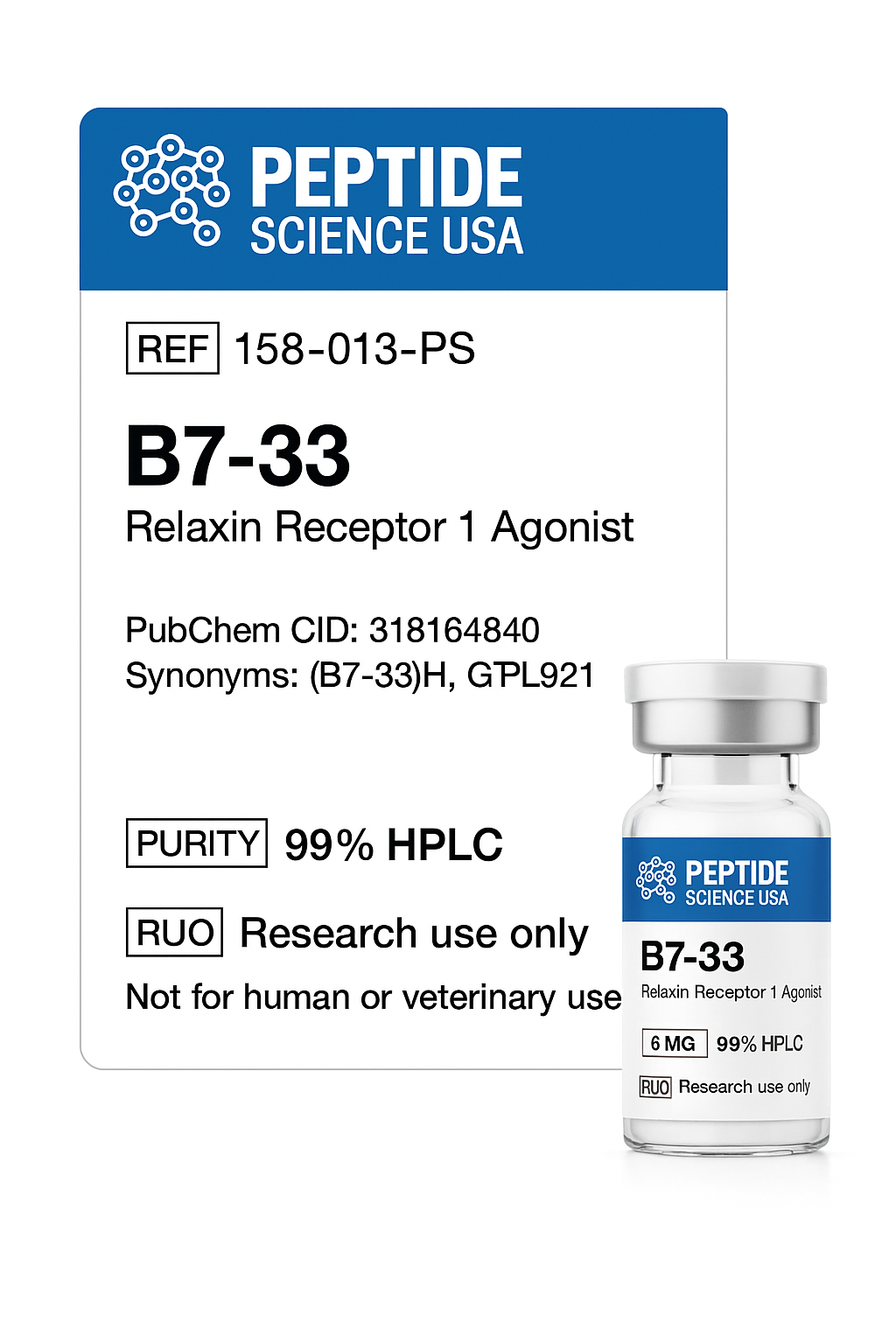
B7-33 For Sale 6mg
$70.00
B7-33 exibits potent anti-fibrotic effects. It is under active research and investigation as a means of reducing fibrosis in acute and chronic diseases like heart failure, lung inflammation, kidney and more.
In animal studies, B7-33 has reduced fibrosis by roughly 50%, leading to prolonged survival following injury and offering the first new means of treating heart failure in 20 years.
It has been shown to reduce excessive scar formation following cardiac injury. It has also shown promise in the treatment of certain vascular disorders as well as preeclampsia of pregnancy
7-33 (6mg) – Targeted Research Solution
B7-33 6mg is a high-affinity, soluble peptide derivative of the human gene H2 relaxin. Specifically engineered for research applications, this 6mg lyophilized vial offers a stabilized format for investigating the potent signaling pathways associated with tissue remodeling and cardiovascular physiology.
Unlike the full-length relaxin hormone, B7-33 is designed to be functionally selective. It focuses on the RXFP1 receptor, which researchers utilize to study the mitigation of fibrotic tissue accumulation and the promotion of vasodilation without the off-target effects often associated with broader hormone analogs.
Key Research Specifications:
-
Purity: \ge 98\% (HPLC verified)
-
Format: Lyophilized white powder
-
Molecular Weight: 3547.16 g/mol
-
Storage: Stable at room temperature during shipping. Long-term storage should be at -20°C to maintain peptide integrity.
Primary Areas of Investigation:
-
Fibrosis Research: Studying the degradation of excess collagen in cardiac, pulmonary, and renal tissues.
-
Cardiovascular Mechanics: Analyzing its role in acute heart failure models and systemic vascular resistance.
-
Anti-Inflammatory Pathways: Exploring the modulation of TGF-$\beta$ signaling and inflammatory cytokine expression.
-
Wound Healing: Investigating potential regenerative properties in skin and soft tissue recovery.
B7-33 6mg is a synthetic research peptide derived from the relaxin hormone family, designed for laboratory studies focused on relaxin receptor signaling, tissue remodeling, and cellular communication pathways. B7-33 is particularly studied for its interaction with the RXFP1 receptor (Relaxin Family Peptide Receptor 1), which plays a role in regulating connective tissue, cardiovascular biology, and cellular repair mechanisms.
Unlike the full relaxin hormone, B7-33 is a single-chain peptide analog engineered to selectively activate certain relaxin-related pathways in experimental models. Because of this targeted activity, it has gained attention in research exploring fibrosis, tissue regeneration, and cell signaling.
The 6mg lyophilized peptide format allows researchers to work with a precise quantity suitable for controlled laboratory experiments and receptor interaction studies.
Frequently Asked Questions
What is B7-33?
B7-33 is a synthetic peptide analog derived from the relaxin hormone family and studied for its interaction with relaxin receptors.
What receptor does B7-33 target?
B7-33 is studied for its activity at the RXFP1 receptor, which plays a role in relaxin signaling pathways.
Why do scientists study B7-33?
Researchers use B7-33 to explore relaxin-related biological processes such as tissue remodeling, fibrosis pathways, and cellular signaling.
Is B7-33 approved for medical use?
B7-33 is primarily classified as a research peptide and is generally used in laboratory studies rather than clinical treatmen
4 reviews for B7-33 For Sale 6mg
Add a review
Related products
Peptides
Peptides
Peptide
Peptides
Peptides
Peptides
Emma Scott –
Skin elasticity and hydration noticeably improved. Feels like a biohacker’s secret weapon
Ryan Coleman –
Used in cellular repair study—tissue response was excellent
Chloe James –
Was testing for anti-fibrosis effects. Worked well in that context
Joshua Bell –
Reduced visible aging signs and improved skin tone. No irritation.