Fragment 176-191, Modified GRF 1-29 & Ipamorelin 12mg Blend — Precision Peptide Stack for Pulsatile GH Release & Fat Loss Research
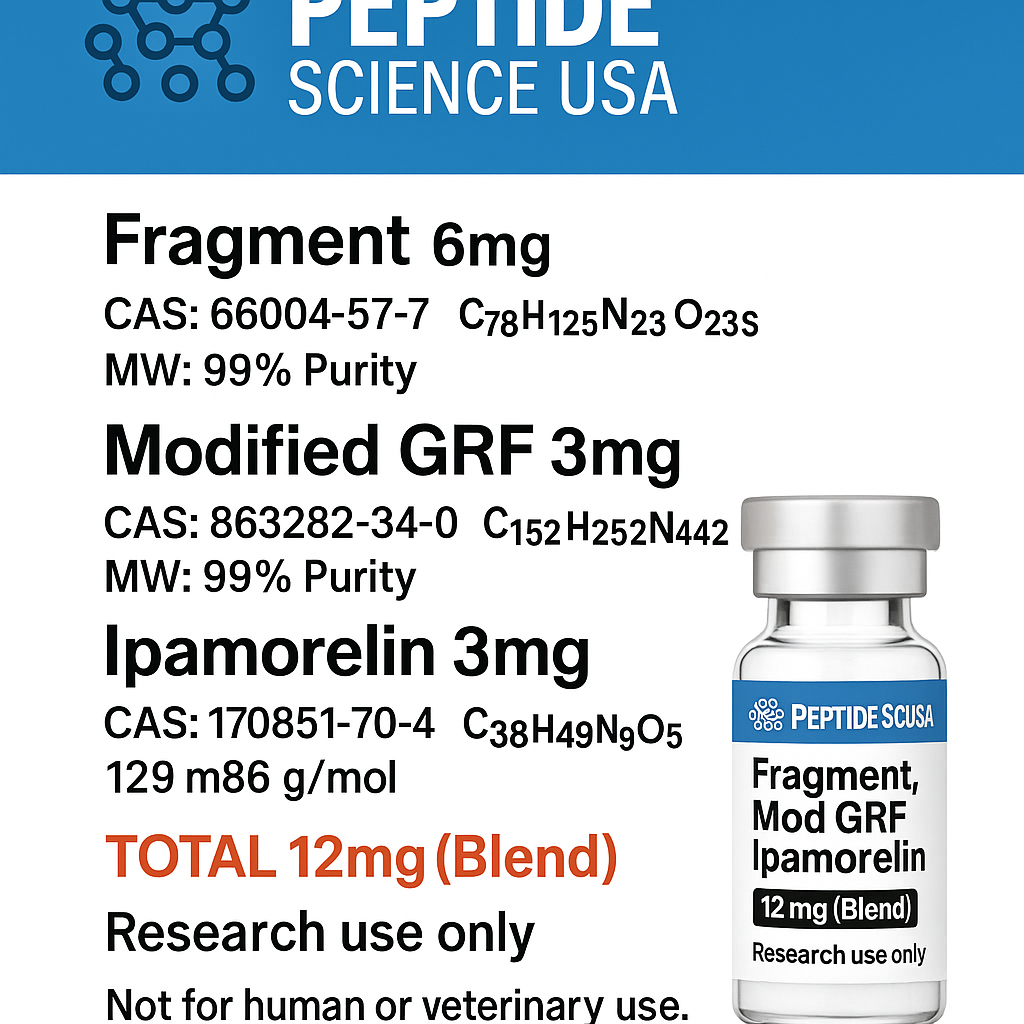
The Fragment 176-191, Modified GRF 1-29, and Ipamorelin 12mg Blend represents a highly targeted tri-peptide research compound engineered to activate multiple nodes of the growth hormone (GH) secretion axis simultaneously. By combining a peripheral fat-targeting peptide with two complementary GH secretagogues — one acting on the GHRH receptor, the other on the ghrelin receptor — this blend offers researchers a synergistic, single-vial tool to study GH dynamics, lipolytic pathways, and body composition modulation.
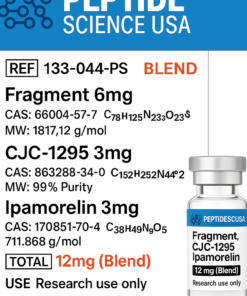
Formulated at a total peptide mass of 12mg per vial, this blend delivers a research-grade concentration designed for serious in vitro and in vivo experimental protocols. Each component has been selected for its distinct but complementary mechanism, and together they represent one of the most studied and replicated peptide combinations in growth hormone axis research.
What Is the Fragment, Modified GRF 1-29 & Ipamorelin 12mg Blend?
This tri-peptide blend integrates Fragment 176-191, Modified GRF 1-29 (also known as Mod GRF 1-29 or CJC-1295 without DAC), and Ipamorelin into a single lyophilized research vial. Each peptide targets a different receptor population, allowing researchers to evaluate the combined effects of simultaneous GHRH receptor stimulation, ghrelin receptor agonism, and peripheral adipose signaling within a single experimental framework.
Unlike blends that rely solely on one pathway, this formulation creates a multi-vector approach to GH axis modulation — making it particularly valuable for studies examining synergistic GH pulse amplification, fat mobilization, and downstream IGF-1 activity.
Fragment 176-191 — The Selective Lipolytic Peptide
Fragment 176-191 is a C-terminal truncation of human growth hormone, corresponding to amino acid residues 176 through 191. This short peptide chain has been identified in preclinical research as the region of the hGH molecule responsible for its fat-metabolizing properties — while being structurally isolated from the regions associated with cell proliferation, glucose dysregulation, or insulin resistance.
Preclinical research has associated Fragment 176-191 with the following activities:
- Potent stimulation of lipolysis in adipocyte cell cultures and animal models
- Inhibition of lipogenesis — reduction in new fat cell formation
- Preferential targeting of visceral and abdominal adipose deposits
- No significant interference with insulin sensitivity at research-relevant concentrations
- Absence of receptor desensitization effects associated with full-length hGH administration
- Activity independent of pituitary GH secretion, enabling direct peripheral fat signaling
Modified GRF 1-29 — The Short-Acting GHRH Analogue
Modified GRF 1-29 (Mod GRF 1-29) is a stabilized analogue of growth hormone-releasing hormone (GHRH), specifically the biologically active 1-29 fragment of native GHRH. It differs from the original Sermorelin (GHRH 1-29) through four strategic amino acid substitutions at positions 2, 8, 15, and 27 — modifications that dramatically extend its plasma half-life from approximately 2 minutes (native GHRH) to roughly 25–30 minutes, while preserving full receptor-binding affinity at the pituitary GHRH receptor.
Unlike CJC-1295 with DAC, Modified GRF 1-29 does not bind to serum albumin and therefore does not produce continuous, steady-state GH elevation. Instead, it mimics the natural episodic pattern of GHRH release — making it ideal for research protocols that require physiologically relevant, pulsatile GH secretion patterns.
Research applications of Modified GRF 1-29 have demonstrated:
- Strong, dose-dependent GH pulse induction through pituitary GHRH receptor activation
- Preserved pulsatility — natural GH secretion rhythms maintained without receptor blunting
- Elevated plasma IGF-1 concentrations following repeated dosing protocols
- Favorable half-life extension compared to native GHRH, without the continuous elevation of DAC-containing variants
- Compatibility with ghrelin-pathway secretagogues, enabling significant GH pulse amplification when co-administered with Ipamorelin
- No significant cortisol, prolactin, or ACTH stimulation at standard research concentrations
Ipamorelin — The Clean, Selective GH Secretagogue
Ipamorelin is a synthetic pentapeptide (Aib-His-D-2-Nal-D-Phe-Lys-NH2) that functions as a potent, highly selective agonist of the ghrelin receptor (GHS-R1a). First characterized in published research in 1998, Ipamorelin rapidly gained recognition as one of the most selective GH secretagogues available due to its ability to drive robust pituitary GH release without the unwanted hormonal side effects associated with earlier GHRP compounds.
In contrast to GHRP-2 and GHRP-6, Ipamorelin does not significantly stimulate cortisol, ACTH, aldosterone, or prolactin release at effective GH-stimulating doses. It also does not induce the pronounced appetite stimulation observed with GHRP-6 — making it a cleaner experimental tool when isolated GH secretagogue effects are the research objective.
Documented research findings for Ipamorelin include:
- Dose-dependent, pulsatile GH release through selective GHS-R1a receptor activation
- Highly specific hormonal action — minimal off-target stimulation of cortisol or prolactin pathways
- Synergistic GH pulse amplification when co-administered with GHRH analogues such as Modified GRF 1-29
- Support for lean muscle anabolic signaling via downstream IGF-1 elevation
- Potential benefits for sleep architecture and recovery, mediated through GH-driven slow-wave sleep enhancement
- Preserved receptor sensitivity over extended research protocols — low tachyphylaxis risk
The Synergistic Science Behind This Tri-Peptide Blend
The Fragment + Modified GRF 1-29 + Ipamorelin combination is built on a well-established principle in peptide pharmacology: simultaneous activation of the GHRH receptor and the ghrelin receptor produces GH pulse amplitudes significantly greater than either agonist achieves independently. This additive-to-synergistic relationship has been documented in multiple preclinical studies and forms the scientific rationale behind the most widely used dual-pathway GH secretagogue stacks in research.
The three-way mechanism of this blend can be summarized as follows:
- Modified GRF 1-29 activates the pituitary GHRH receptor, priming somatotroph cells for GH synthesis and release — the baseline amplification component.
- Ipamorelin activates the GHS-R1a ghrelin receptor simultaneously, triggering an acute GH pulse — the peak amplification component.
- Fragment 176-191 acts peripherally and independently at the adipose level, stimulating fat mobilization through a direct cellular lipolysis pathway — regardless of the central GH response.
The result is a three-pronged research model: central GH pulsatility amplified through dual receptor activation, paired with direct peripheral fat signaling — all delivered in a single, convenient 12mg blend vial that eliminates the need for separate reconstitution and concurrent administration of three individual peptide compounds.
Product Specifications & Quality Standards
Technical Specifications
- Total Peptide Content: 12mg per vial
- Composition: Fragment 176-191 / Modified GRF 1-29 / Ipamorelin (blend ratio available on request)
- Purity: ≥98% by HPLC analysis
- Physical Form: Lyophilized (freeze-dried) white to off-white powder
- Reconstitution Solvent: Sterile bacteriostatic water recommended (not included)
- Storage — Lyophilized: 2–8°C (refrigerator); long-term at -20°C
- Storage — Reconstituted: 2–8°C; use within 28–30 days
- Vial Type: Sealed amber glass vial with rubber stopper and aluminum crimp cap
- Shelf Life: 24 months (lyophilized, sealed)
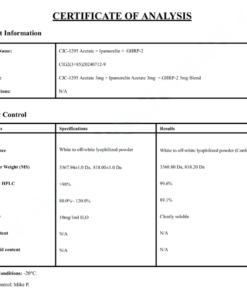
- Certificate of Analysis: Available per batch upon request
Third-Party Quality Verification
Every batch of this peptide blend undergoes comprehensive independent laboratory analysis to verify identity, purity, and safety before release. Our quality assurance process includes:
- High-Performance Liquid Chromatography (HPLC) — purity verification to ≥98%
- Mass Spectrometry (MS/MS) — molecular identity and sequence confirmation for all three peptide components
- Limulus Amebocyte Lysate (LAL) endotoxin testing — pyrogen-free verification
- Residual solvent analysis — synthesis solvent clearance confirmation
- Amino acid analysis — composition and ratio verification
- Sterility and vial integrity inspection prior to dispatch
Research Applications of Fragment, Modified GRF 1-29 & Ipamorelin Blend
Pulsatile Growth Hormone Secretion Studies
The Modified GRF 1-29 and Ipamorelin pairing is one of the most extensively studied dual-pathway GH secretagogue models in peptide research. Because Modified GRF 1-29 does not bind albumin, it preserves the natural episodic pattern of GH release — a critical distinction for researchers studying physiological GH dynamics, somatotroph cell biology, and neuroendocrine pulse generation. This blend is therefore particularly suited to studies where replicating natural GH pulsatility is methodologically important.
Adipose Tissue Biology & Fat Metabolism Research
Fragment 176-191 provides this blend with a direct peripheral lipolysis component, making it especially valuable for metabolic research focused on adipose tissue biology. Studies investigating visceral fat reduction, substrate partitioning, fatty acid mobilization, and the cellular mechanisms of GH-independent lipolysis will benefit from the inclusion of this well-characterized fat-targeting peptide fragment.
IGF-1 Axis & Anabolic Signaling Research
The combined GH-stimulating effect of Modified GRF 1-29 and Ipamorelin produces consistent downstream elevation of IGF-1, the primary mediator of GH anabolic effects on skeletal muscle, bone, and connective tissue. Researchers studying lean mass preservation, protein synthesis signaling, musculoskeletal recovery, and collagen turnover will find this blend a valuable tool for driving and measuring IGF-1 pathway activity.
Age-Related GH Decline & Somatopause Research
Age-associated decline in pulsatile GH secretion — commonly referred to as somatopause — is an active area of longevity and geroscience research. The natural, pulsatile GH secretion pattern produced by Modified GRF 1-29 and Ipamorelin makes this blend a relevant model for studying the restoration of youthful GH profiles, and the downstream effects on bone mineral density, skin collagen synthesis, adipose redistribution, and metabolic rate in aging subject models.
Sleep & Recovery Mechanism Studies
Growth hormone secretion is intimately linked with slow-wave (deep) sleep, and GH secretagogues have been studied for their potential to enhance sleep architecture by augmenting nocturnal GH pulsatility. Research examining the relationship between GH axis activation, sleep quality, cellular repair processes, and recovery from physiological stress may use this blend to investigate these sleep-associated GH mechanisms in controlled experimental settings.
Storage, Reconstitution & Handling Protocol
Maintaining the structural integrity of lyophilized peptide blends requires adherence to established research-standard handling procedures. Follow these guidelines to preserve full peptide activity throughout your research protocol:
- Pre-reconstitution storage: Keep lyophilized vials refrigerated at 2–8°C. For extended storage beyond 6 months, freeze at -20°C. Protect from light and moisture at all times.
- Avoid freeze-thaw cycling: Repeated temperature cycling degrades peptide integrity. Reconstitute only the volume needed for immediate use.
- Reconstitution solvent: Use sterile bacteriostatic water (0.9% benzyl alcohol) for extended post-reconstitution stability. Sterile water for injection may be used for single-use applications.
- Reconstitution technique: Inject solvent slowly down the inside wall of the vial — never directly onto the lyophilized cake. Gently swirl; do not agitate or vortex.
- Post-reconstitution storage: Store at 2–8°C and use within 28–30 days. Do not freeze reconstituted solution.
- Label discipline: Record reconstitution date, final concentration, and solvent type on each vial for accurate research documentation.
- UV protection: Store away from direct light. Amber vials are provided for this purpose; keep in original packaging when not in use.
Why Source This Blend from Us?
- Independently Verified Purity — Every batch tested by third-party HPLC and MS laboratories. COAs available on request.
- Authentic Peptide Identity — Mass spectrometry confirms molecular identity of all three components: Fragment 176-191, Modified GRF 1-29, and Ipamorelin.
- Research-Grade Synthesis — Produced via solid-phase peptide synthesis (SPPS) under strict quality controls with full residual solvent clearance.
- Lyophilized for Stability — Freeze-drying maximises shelf life and ensures potency is maintained through shipping and storage.
- Precise Blend Ratios — Consistent inter-vial formulation ratios ensure reproducible results across your entire research series.
- Fast, Discreet Shipping — Secure, temperature-aware packaging with express delivery options available.
- Dedicated Research Support — Our specialist team can assist with protocol questions, reconstitution guidance, and compound selection.
Frequently Asked Questions
What is the difference between Modified GRF 1-29 and CJC-1295 with DAC?
Modified GRF 1-29 and CJC-1295 without DAC are the same compound. CJC-1295 with DAC adds a Drug Affinity Complex that binds serum albumin, extending the half-life to 6–8 days and producing continuous, non-pulsatile GH elevation. Modified GRF 1-29 has a half-life of approximately 25–30 minutes and produces physiologically natural, pulsatile GH release — a key distinction for research requiring episodic GH patterns rather than steady-state GH elevation.
Why is Ipamorelin preferred over GHRP-2 or GHRP-6 in research blends?
Ipamorelin is regarded as the most selective GH secretagogue in the GHRP family. Unlike GHRP-2 (which elevates cortisol and prolactin) or GHRP-6 (which strongly stimulates appetite via ghrelin), Ipamorelin produces selective GH release with minimal off-target hormonal activation. This selectivity makes it a cleaner experimental variable in research protocols where isolated GH axis effects are required.
How does Fragment 176-191 differ from full-length hGH?
Full-length human growth hormone (hGH) exerts both anabolic (muscle-building) and lipolytic (fat-burning) effects, but it also carries risks of insulin resistance, joint swelling, and cellular proliferation at supraphysiological doses. Fragment 176-191 isolates only the lipolytic region of the hGH molecule, retaining fat-targeting activity while removing the cell-proliferating and insulin-interfering domains — making it a more targeted tool for adipose-focused research.
Is a Certificate of Analysis (COA) available for this blend?
Yes. A full third-party COA confirming purity, molecular identity by MS, and endotoxin status is available for every production batch. Contact our support team with your order reference number to receive your batch-specific documentation.
Order Fragment, Modified GRF 1-29 & Ipamorelin 12mg Blend Today
Elevate your GH axis research with one of the most scientifically grounded tri-peptide blends available. Our Fragment, Modified GRF 1-29, Ipamorelin 12mg Blend combines verified purity, precise tri-component formulation, and the synergistic power of pulsatile GH release with direct peripheral fat signaling — all in a single research-grade vial. Order today for fast, discreet delivery with full quality documentation.
5 reviews for Fragment, Modified GRF, Ipamorelin 12mg (Blend)
Add a review
Related products
Peptide Blends
Peptide Blends
Peptide Blends
Peptide Blends
Peptide Blends
Peptide Blends
Rachel Moon –
Amazing for fat burning and smoother muscle tone
Luis Mendez –
Saw visible changes in my body within two weeks
Stacey Connors –
Really helps with definition. Plus, no bloating
Tyler Nash –
The trio in this blend really kicks fat loss into gear
Carmen Diaz –
Effective and clean. Noticed results without any weird side effects