Nonapeptide-1 (Melanostatine-5) | 200mg High-Purity Research Vial
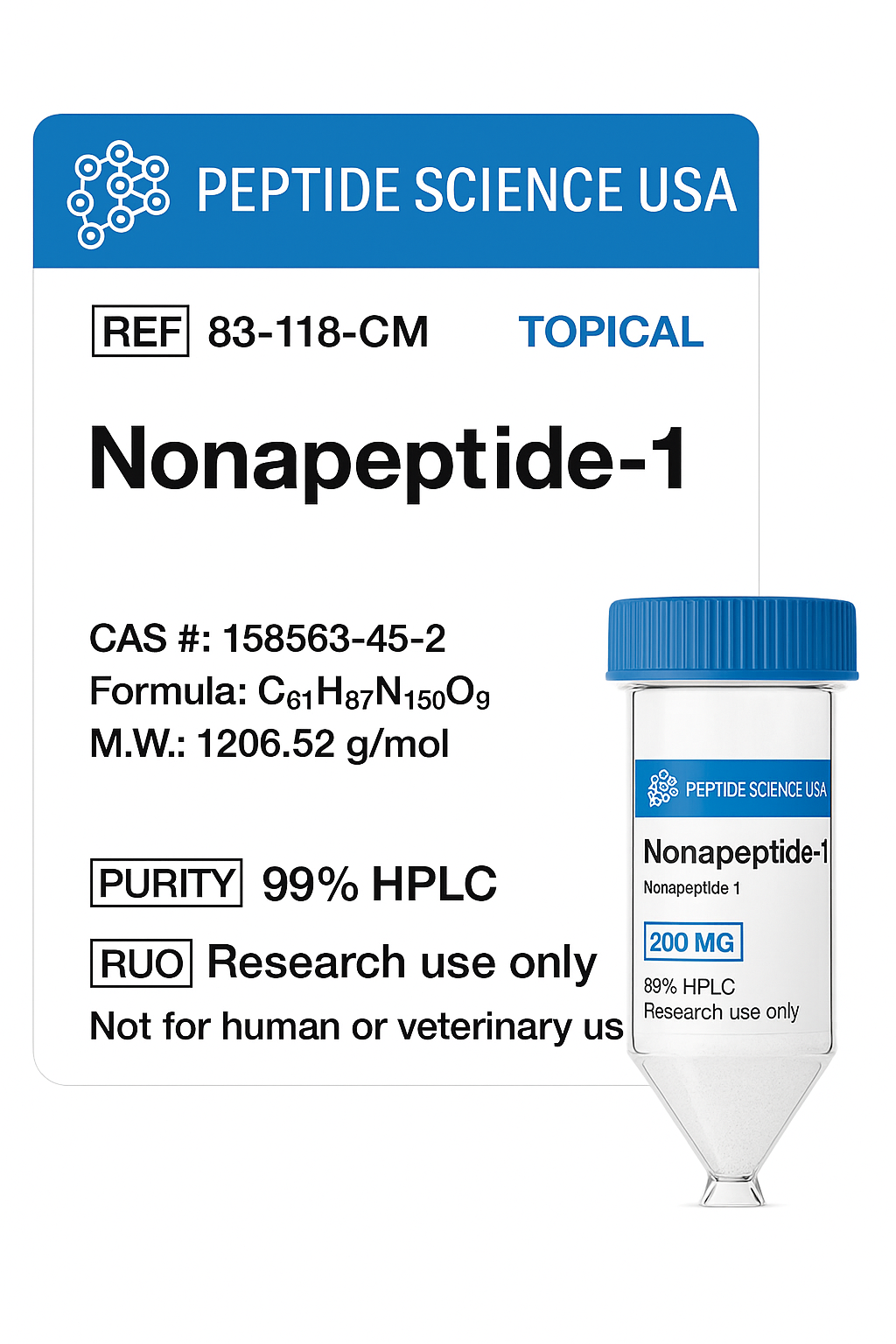
Nonapeptide-1 is a potent biomimetic peptide primarily researched for its role as an antagonist to the Melanocyte-Stimulating Hormone ($\alpha$-MSH). In laboratory studies, it is frequently utilized to investigate the pathways of melanogenesis, specifically focusing on its ability to inhibit tyrosine synthesis and regulate skin pigmentation markers.
The 200mg vial provides a concentrated supply for researchers conducting extensive longitudinal studies or high-volume topical formulation testing.
Technical Specifications
-
Amino Acid Sequence: Met-Pro-D-Phe-Arg-D-Trp-Phe-Lys-Pro-Val
-
Purity: ≥98% (HPLC verified)
-
Molecular Formula: $C_{61}H_{87}N_{15}O_{9}S$
-
Format: Lyophilized white powder
-
Storage: Stable at room temperature for shipping. Store at -20°C for long-term stability and to prevent peptide degradation.
Research Overview
-
Melanogenesis Inhibition: Nonapeptide-1 is widely studied for its ability to block the $\alpha$-MSH signal, which is a primary trigger for melanin production in melanocytes.
-
Skin Brightening Research: Researchers often focus on its potential to reduce hyperpigmentation, dark spots, and uneven skin tone in dermatological models.
-
Non-Cytotoxic Action: Unlike some aggressive chemical lightening agents, Nonapeptide-1 is investigated for its selective action, aiming for efficacy without compromising cell viability.
Reconstitution & Handling
Reconstitute the lyophilized powder with Bacteriostatic Water or sterile saline for research applications. Once in liquid form, the solution must be stored in a refrigerator (2°C – 8°C) and used within approximately 21 days to maintain maximum potency.
Nonapeptide-1200mg
Nonapeptide-1, also called Melanostatine™™ 5, is a propriety peptide that was originally developed for its antimicrobial activities. Animal research has revealed, however, that nonapeptide-1 can inhibit the synthesis of melanin, which makes it of interest for treating certain skin conditions. Animal models suggest that nonapeptide-1 can reduce synthesis of melanin and help decrease skin pigmentation to a substantial degree.
Research Application:
Nonapeptide-1 is of primary research interest for its ability to reduce hyperpigmentation by inhibiting the action of tyrosinase in melanin-producing cells. The ability to regulate melanin production has potential application in a number of conditions, including photodamage of the skin.
- Research also suggests that nonapeptide-1 may play a role in the central nervous system where it may act on both dopaminergic receptors and opioid receptors to modify pain signaling as well as behavior. Studies in mice support the idea that nonapeptide-1 may have central actions that affect behavior and pain.
What Is Nonapeptide-1?
Nonapeptide-1 was first isolated from the yeast Streptomyces clavifer, but is now produced synthetically through recombinant genetic technology. It was first developed for its antimicrobial activities, but has since been found to be a strong inhibitor of melanin formation laboratory studies of yeast and melanoma (skin cancer) cells. Nonapeptide-1 consists of the amino acids arginine-lysine-methionine-phenylalanine-proline-tryptophan-valine.
What Does Nonapeptide-1 Do?
In cosmeceutical terms, nonapeptide-1 is a radiance promoter and whitening agentv. In technical terms it is a melanin synthesis inhibitor that works by interfering with the action of tyrosinase. Tyrosinase is the primary enzyme responsible for the synthesis of melanin in specialized cells called melanocytes. Any interference with tyrosinase prevent melanocytes from producing pigmentv. By inhibiting tyrosinase, nonapeptide-1 can help to reduce pigment production in the skin in animal studies and thus lighten darker areas that have been damaged by the sun and certain diseases.
There is some evidence that nonapeptide-1 acts by interfering with melanocyte stimulating hormone (MSH). MSH increases during pregnancy, as a result of certain medical conditions (e.g. diabetes, Addison’s disease), and as a result of excessive sun exposure. MSH is a derivative of adrenocorticotropic hormone. Synthetic analogues of MSH, such as melanotan II, mimic the effects of the natural molecule and can lead to skin darkening. Interestingly, not everyone responds to MSH. Red-heads, for instance, do not tan well because they have variations in their MSH receptors that result in poor response to MSH in the blood.
Nonapeptide-1 Research on Skin Lightening
Research in fungi indicates that nonapeptide-1, at a concentration of 200 ug/mL, is capable of fully inhibiting the synthesis of melanin2. Fungi are used in this particular research because they more closely approximate conditions in human cells, but require fewer resources than animal models. Research in animal models indicates that nonapeptide-1 may effectively reduce pigmentation, after just one application, for up to 28 days at a timev[5]. At 100 micromolar concentration, nonapeptide-1 can inhibit 25-35% of tyrosinase activity in animal models and can reduce the melanin content of melanocytes by 27-43%.
5 reviews for Nonapeptide-1 200mg Online
Add a review
Related products
Cosmetic Peptides
Cosmetic Peptides
Cosmetic Peptides
Cosmetic Peptides
Cosmetic Peptides
Cosmetic Peptides
Cosmetic Peptides
Cosmetic Peptides
Abigail Long –
Great product for lightening dark spots.
Sean Turner –
Works well with my vitamin C serum.
: Grace Hall –
My skin is noticeably brighter.
Alex Ward –
Excellent brightening effect without irritation.
Rebecca Diaz –
Skin tone is more even and glowing.