
Decapeptide-12 200mg | High-Purity Research Grade Peptide
Comprehensive Overview of Decapeptide-12 (200mg)
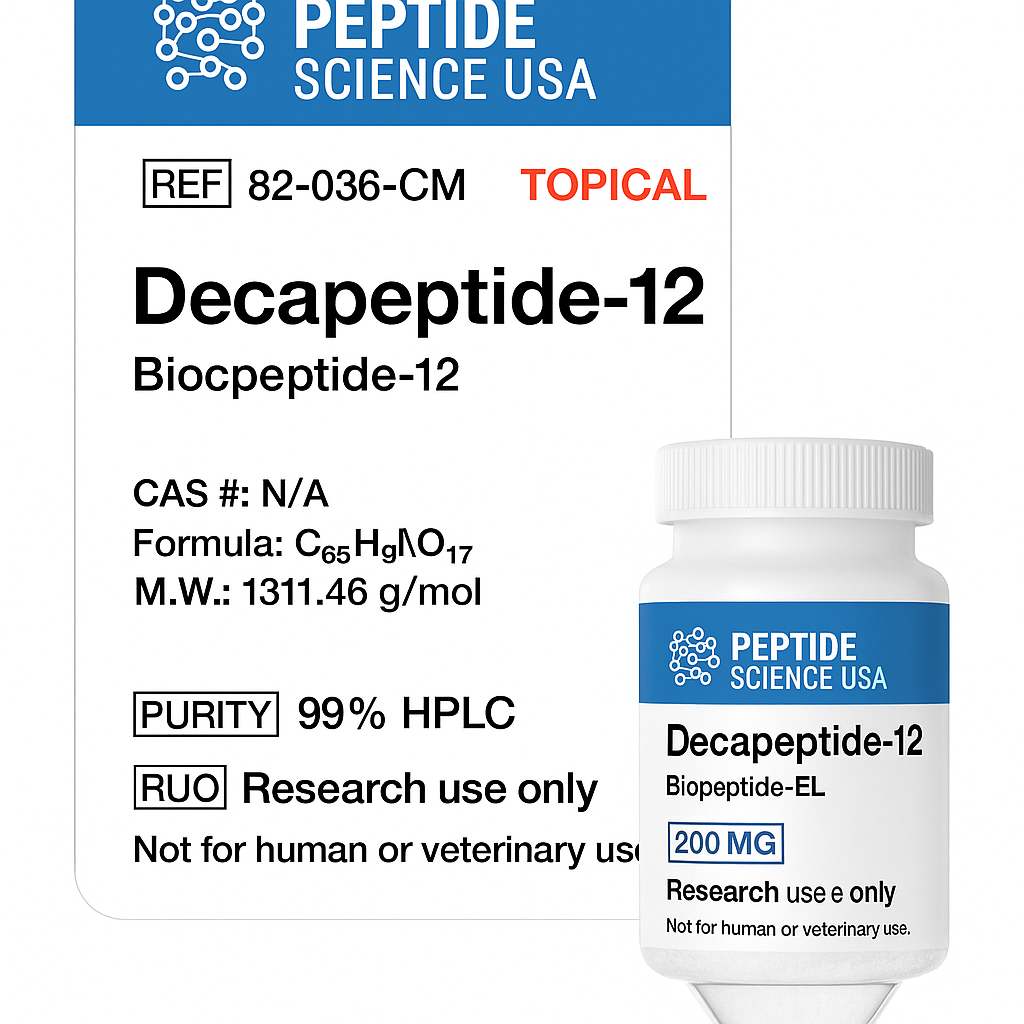
The Decapeptide-12 200mg vial is a specialized research compound primarily utilized in the study of melanogenesis and enzymatic inhibition. Scientifically recognized for its ability to bind to the tyrosinase enzyme, Decapeptide-12 is a key focus for researchers investigating the modulation of pigment synthesis without the cytotoxic effects associated with traditional lightening agents.
By providing a substantial 200mg concentration, this product is engineered for rigorous laboratory environments. This higher volume allows for the creation of standardized stock solutions across multiple experimental arms, ensuring that data regarding melanin reduction and cellular signaling remains consistent and reproducible.
Technical Specifications and Biochemical Profile
Molecular Precision and Sequence Analysis
Our Decapeptide-12 is synthesized using advanced peptide chemistry to ensure a purity level of $\ge$ 98%. Each batch is strictly verified through High-Performance Liquid Chromatography (HPLC) and Mass Spectrometry (MS) to confirm its unique amino acid sequence and molecular weight.
-
Sequence: Tyr-Arg-Ser-Arg-Lys-Tyr-Ser-Ser-Trp-Tyr
-
Molecular Formula: $C_{65}H_{90}N_{18}O_{17}$
-
Molecular Weight: Approximately $1395.5 \text{ g/mol}$
-
Form: Lyophilized white crystalline powder
-
Concentration: 200mg per sterile vial
Reconstitution and Laboratory Storage
To preserve the structural integrity of the Decapeptide-12 200mg lyophilized cake, adherence to cold-chain storage and precise reconstitution is paramount:
-
Reconstitution: Best dissolved in sterile deionized water or a buffered saline solution.
-
Mixing: Gently rotate the vial to allow the powder to dissolve; avoid vigorous shaking to prevent peptide aggregation.
-
Storage: The lyophilized powder should be stored at -20°C for long-term stability. Once in solution, it should be kept at 2°C to 8°C and utilized within a short experimental window to maintain peak bio-activity.
Research Applications and Scientific Utility
Tyrosinase Inhibition and Pigment Modulation
Decapeptide-12 is a primary reagent for studying the tyrosinase pathway. Unlike other inhibitors that may cause cell death, Decapeptide-12 acts as a competitive inhibitor. Researchers utilize the 200mg concentration to investigate:
-
Melanin Synthesis Inhibition: Observing the reduction of pigment formation in melanocyte cultures.
-
Enzyme Binding Kinetics: Analyzing the affinity between the peptide and the tyrosinase enzyme at varying concentrations.
-
Dermal Safety Models: Evaluating the non-cytotoxic nature of peptide-based modulation compared to hydroquinone or other aggressive reagents.
Advanced Comparative Research
The 200mg Decapeptide-12 format is ideal for high-throughput screening. It allows labs to conduct extensive dose-response curves to determine the minimum effective concentration for pigment regulation in various tissue models, including 3D skin equivalents.
5 reviews for Decapeptide 12
Add a review
Related products
Cosmetic Peptides
Cosmetic Peptides
Cosmetic Peptides
Cosmetic Peptides
Cosmetic Peptides
Cosmetic Peptides
Cosmetic Peptides
Cosmetic Peptides
Brooke Simmons –
This version is a bit stronger. I love the results.
Carl Jenkins –
cjenkins.decapeptide@gmail.com
Andrea Ford –
No irritation and visible lightening of dark patches.
Scott Bailey –
Noticeably reduces discoloration and softens my skin.
Megan Lane –
Love this for my hyperpigmentation issues.