COAMatrixyl Cosmetic PeptideCertificate
Matrixyl Cosmetic Peptide | High-Performance Research Grade Solution
Comprehensive Overview of Matrixyl (Palmitoyl Pentapeptide-4)
Matrixyl, scientifically known as Palmitoyl Pentapeptide-4, is one of the most recognized and rigorously studied cosmetic peptides in the field of biochemical research. This specific formulation is a lipophilic peptide, meaning it is attached to a palmitoyl chain to significantly enhance its permeability across cellular lipid bilayers. In laboratory settings, Matrixyl is primarily utilized to study the mechanisms of the extracellular matrix (ECM) and the natural synthesis of structural proteins.
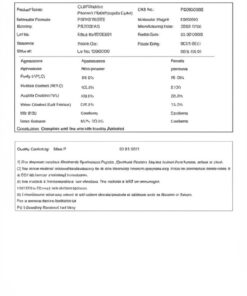
HPLC Matrixyl Cosmetic Peptide Certificate
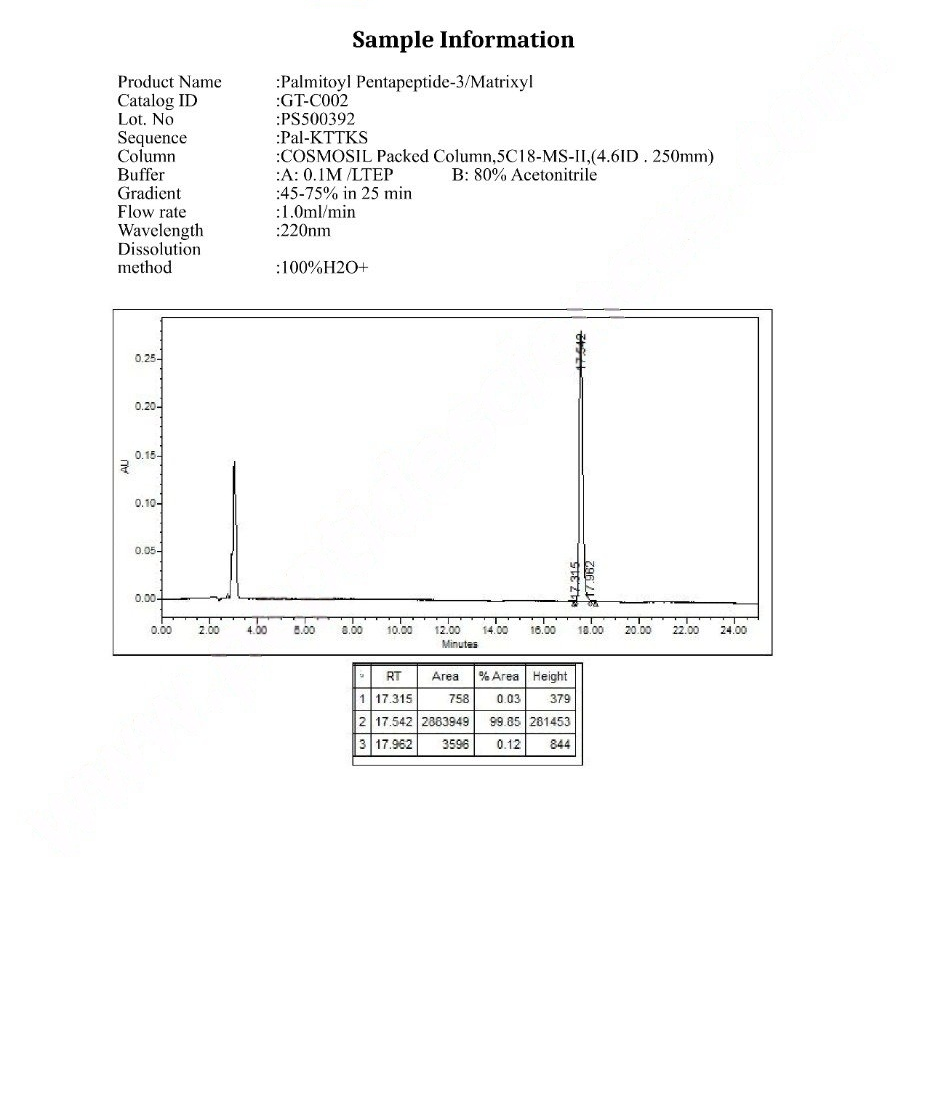
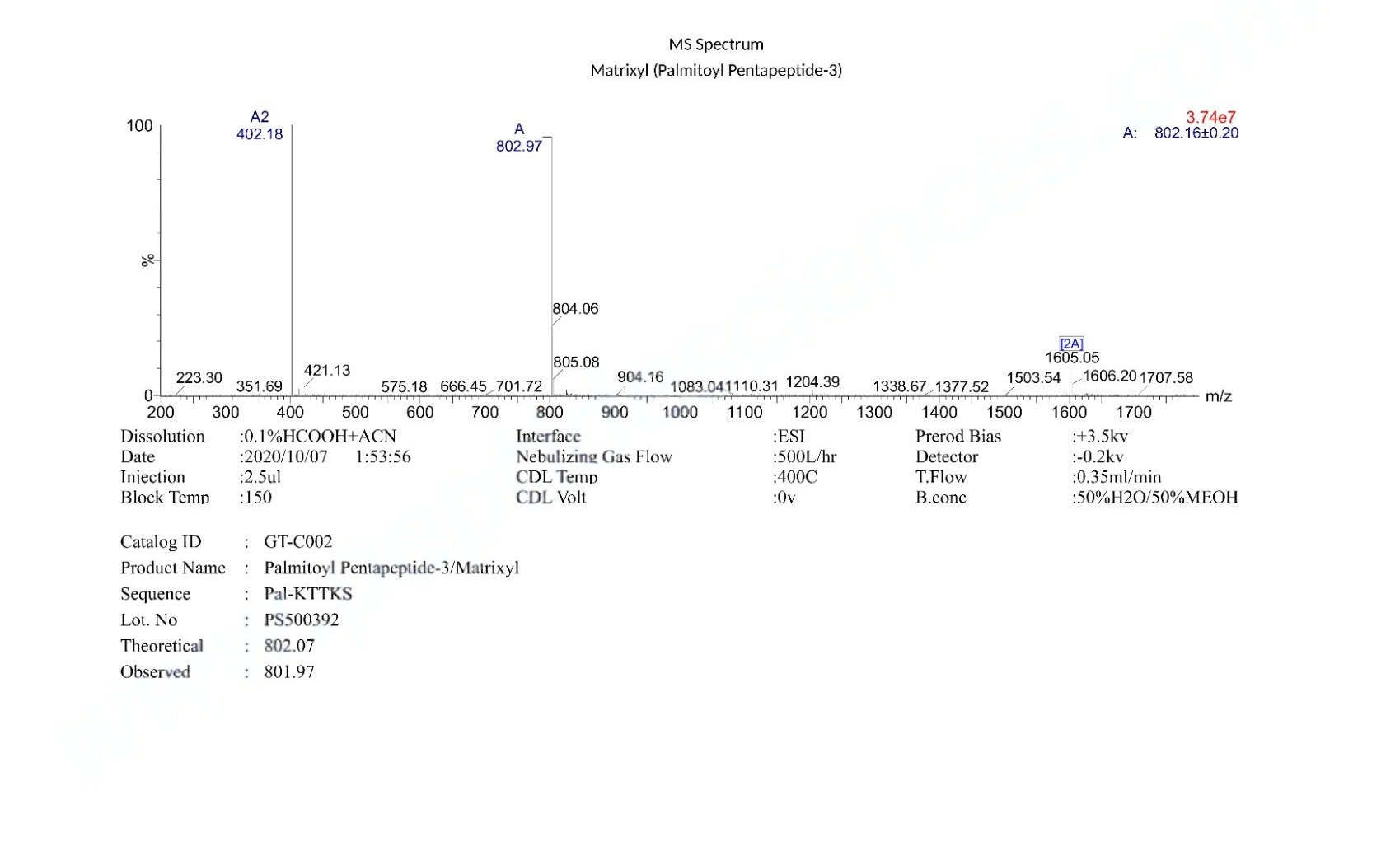
MS Matrixyl Cosmetic Peptide Certificate
Application
Matrixyl stimulates the lower layers of the skin to heal themselves, thus accelerating the healing of wounds. Cells called fibroblasts are responsible for knitting together wounds of the skin. As you may know, as one ages wounds take longer to heal. This is partially because fibroblasts slowly lose the capacity for collagen production. Matrixyl is the trademark name for palmitoyl pentapeptide-3, one of the powerful peptide molecules found in the latest generation of high-end anti wrinkle skin care products. Matryxil becomes even more effective when combined with other peptides
What is Matrixyl
Matrixyl is a lipopeptide, a fatty acid mixed with amino acids. It is also considered to be a synthetic isomer (an isomer is a molecule that has an identical structure to another molecule but different atomic components). The active element in Matrixyl is called Micro-collagen – another peptide.
What does Matrixyl do?
Matrixyl was discovered through two branches of dermatological research: the search for substances that accelerate healing skin wounds and the study of what causes wrinkles. Similarly to copper peptides, Matrixyl stimulates the lower layers of the skin to heal themselves, thus accelerating the healing of wounds. Cells called fibroblasts are responsible for knitting together wounds of the skin. As you may know, as one ages wounds take longer to heal. This is partially because fibroblasts slowly lose the capacity for collagen production.
Matrixyl stimulates the “matrix” layers in the skin — primarily collagen and fibronectin. When stimulated, the skin produces more collagen. Loss of collagen is what leads to thinning skin and the wrinkling of newly inelastic skin. Matrixyl helps to counteract this natural part of the aging process.
Is Matrixyl (palmitoylpentapeptide-3) an effective anti wrinkle product?
Yes. In clinical studies, Matrixyl was shown to:
– Increase overall collagen synthesis by up to 117%
– Increase collagen IV synthesis by up to 327%
– Increase hyaluronic acid synthesis by up to 267%
Deep wrinkles were reduced by half. Smaller wrinkles and fine lines sometimes faded completely away. And what’s even better, every participant in the study showed noticeable improvement within two weeks. The result was fewer wrinkles and younger-looking skin. There are very few ingredients that show more promise and greater effectiveness than Matrixyl. When combined with other peptides (as in the Replexion formula) the results are even more effective.
By providing a high-purity, research-grade variant of this peptide, laboratories can conduct precise investigations into cellular signaling. Matrixyl acts as a “matrikine”—a messenger peptide that mimics the fragments of broken-down collagen. This mimicry triggers a biological feedback loop that researchers monitor to understand the stimulation of collagen types I, III, and IV, as well as the production of fibronectin and glycosaminoglycans.
Technical Specifications and Biochemical Properties
Molecular Composition and Synthesis
Our Matrixyl Cosmetic Peptide is synthesized using precision laboratory techniques to ensure a peptide purity level of $\ge$ 98%. The inclusion of the palmitic acid chain is critical for researchers focused on topical delivery models and absorption kinetics.
-
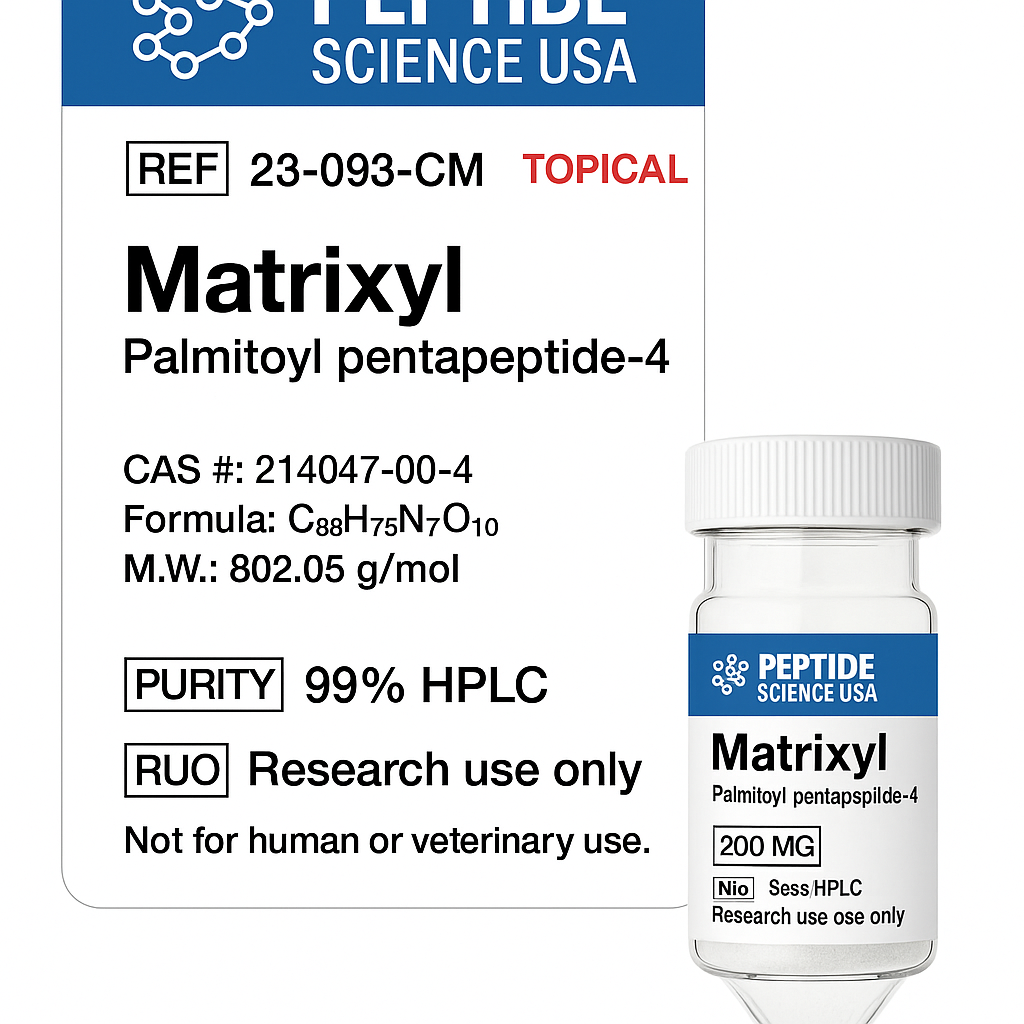
Chemical Name: Palmitoyl-Lys-Thr-Thr-Lys-Ser
-
Molecular Formula: $C_{39}H_{75}N_{7}O_{10}$
-
Molecular Weight: Approximately $802.05 \text{ g/mol}$
-
Appearance: Lyophilized white powder
-
Solubility: Soluble in water, glycerin, and propanediol
Reconstitution and Storage Protocol
To ensure the stability of the Palmitoyl Pentapeptide-4 chain, proper handling is essential. The lyophilized powder should be stored at -20°C for long-term stability. For experimental use:
-
Solvent Selection: Use sterile deionized water or a buffered solution (pH 5.0–7.0).
-
Reconstitution: Gently agitate the vial; avoid high-speed vortexing which may shear the peptide bonds.
-
Storage: Once in liquid form, keep refrigerated at 2°C to 8°C and use within a 30-day window to maintain maximum bio-activity.
Laboratory Research Applications
Extracellular Matrix (ECM) Stimulation
Researchers utilize Matrixyl to observe the upregulation of Type I Collagen and Hyaluronic Acid. Because the peptide mimics the breakdown products of collagen, it serves as a primary tool for studying the skin’s natural repair mechanisms in in vitro dermal fibroblast cultures.
Comparative Anti-Aging Studies
Matrixyl is often used as a benchmark in comparative studies against other retinoids or vitamin C derivatives. Research focuses on its ability to provide signaling cues without the inflammatory response often associated with more aggressive chemical agents. This makes it a staple for labs focusing on:
-
Fibroblast proliferation and migration.
-
Dermal-epidermal junction (DEJ) reinforcement.
-
Protein synthesis pathways in aged or UV-damaged cell models.
5 reviews for Matrixyl Cosmetic Peptide
Add a review
Related products
Cosmetic Peptides
Cosmetic Peptides
Cosmetic Peptides
Cosmetic Peptides
Cosmetic Peptides
Cosmetic Peptides
Cosmetic Peptides
Cosmetic Peptides
Henry Brooks –
Hands down the best for wrinkle reduction.
Alexis Reed –
I’ve used Matrixyl for years. This version is excellent.
Paul Evans –
A classic that still delivers visible improvements.
Madison Carter –
Layers beautifully under moisturizer.
Eric Morgan –
Works fast, especially on forehead lines.